
逻辑时钟
逻辑时钟
什么是逻辑时钟
1978 年,Lamport 在 Time, Clocks, and the Ordering of Events in a Distributed System 中提出了逻辑时钟的概念,来解决分布式系统中区分事件发生的时序问题。
逻辑时钟指的是分布式系统中用于区分事件的发生顺序的时间机制。
为什么需要逻辑时钟
对于程序来说,时间维度非常重要,很多业务逻辑都依赖于时间。常见的场景有:
- 某个请求是否超时了?
- 某项服务 P99 的响应时间是多少?
- 在过去五分钟,服务平均每秒处理多少个查询?
- 用户在我们的网站上浏览花了多段时间?
- 这篇文章什么时候发表?
- 在什么时间发送提醒邮件?
- 这个缓存条目何时过期?
- 日志文件中错误消息的时间戳是多少?
分布式系统,意味着整个系统中有多个节点。为了让多节点的系统时间保持同步,需要有一个对表机制,来保证各节点的时间一致。一种常见方法是使用 NTP,它的工作机制是使用专门的高精度时间服务器来作为基准,调整服务器的本地时间。即使使用了 NTP,也难免存在微小的误差,在有些场景中(如金融)是不能接受的。
在分布式系统中,由于跨节点通信不可能即时完成,因此在多节点上难以确定事件的先后顺序。而逻辑时钟就是一种定义时序先后顺序的方案。
特性
逻辑时钟具有以下核心特性:
| 特性 | 说明 |
|---|---|
| 不依赖物理时钟 | 通过事件发生的因果关系来确定顺序,不依赖 NTP 等时间同步 |
| 偏序关系 | 有因果关系的事件可以比较顺序,无因果关系的事件无法比较 |
| 单调递增 | 时间戳值随事件发生单调递增 |
| 因果一致性 | 如果事件 A 导致事件 B,则 A 的时间戳一定小于 B |
| 无法保证物理先后 | 时间戳小的事件不一定在物理时间上先发生 |
不同逻辑时钟的对比
| 类型 | 结构 | 能否判断因果 | 能否判断并发 | 适用场景 |
|---|---|---|---|---|
| Lamport 时间戳 | 标量(单个整数) | 能(部分) | 不能 | 全序排序、互斥 |
| 向量时钟 | 向量(数组) | 能 | 能 | 冲突检测 |
| 版本向量 | 向量(数组) | 能 | 能 | 数据版本管理 |
| Dotted Version Vector | 向量 + 事件 ID | 能 | 能 | 高性能版本管理 |
Lamport 时间戳的局限性
Lamport 时间戳虽然能得到事件的全序关系,但存在一个重要局限:C(a) < C(b) 不意味着 a -> b。也就是说,时间戳小的事件不一定发生在时间戳大的事件之前,它们可能是并发的。
向量时钟解决了这个问题,能够准确判断两个事件是因果关系还是并发关系。
全序和偏序
全序和偏序是集合论中的概念,用于描述集合中元素之间的关系。
什么是偏序
偏序是指集合中的元素之间存在一种关系,使得任意两个元素之间可能存在比较,但不一定所有元素都可以相互比较。这种关系不一定是传递的或者反对称的。例如,集合中的子集关系就是一个偏序关系,因为不是所有的子集都可以相互比较。
设 R 是集合 A 上的一个二元关系,若 R 满足:
(1)自反性:对任意 x∈A,有 xRx;
(2)反对称性(即反对称关系):对任意 x,y∈A,若 xRy,且 yRx,则 x=y;
(3)传递性:对任意 x,y,z∈A,若 xRy,且 yRz,则 xRz。
则称 R 为 A 上的偏序关系。
什么是全序
全序是指集合中的元素之间存在一种关系,使得任意两个元素都可以进行比较,且这种比较关系是传递的,反对称的。换句话说,任意两个元素都可以比较大小,并且不会出现无法比较的情况。例如,实数集合上的小于等于关系就是一个全序关系。
设集合 X 上有一全序关系,如果我们把这种关系用 ≤ 表述,则下列陈述对于 X 中的所有 a, b 和 c 成立:
如果 a ≤ b 且 b ≤ a 则 a = b(反对称性)
如果 a ≤ b 且 b ≤ c 则 a ≤ c(传递性)
a ≤ b 或 b ≤ a (完全性)
注意:
时序的关键
**两个事件可以建立因果(时序)关系的前提是:两个事件之间是否发生过信息传递。**在分布式系统中,进程间通信的手段(共享内存、消息发送等)都属于信息传递,如果两个进程间没有任何交互,实际上他们之间内部事件的时序也无关紧要。但是有交互的情况下,特别是多个节点的要保持同一副本的情况下,事件的时序非常重要。
逻辑时钟
分布式系统中按是否存在节点交互可分为三类事件,一类发生于节点内部,二是发送事件,三是接收事件。Lamport 时间戳原理如下:
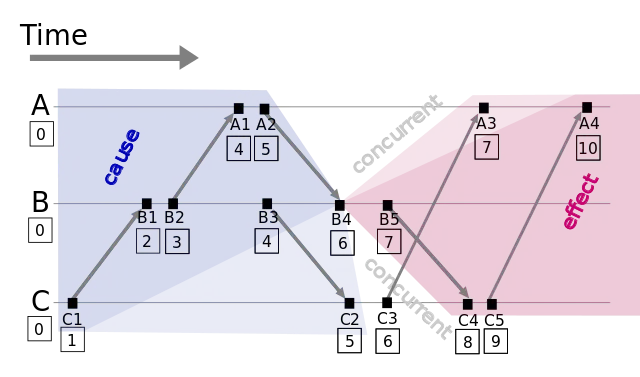
- 每个事件对应一个 Lamport 时间戳,初始值为 0
- 如果事件在节点内发生,时间戳加 1
- 如果事件属于发送事件,时间戳加 1 并在消息中带上该时间戳
- 如果事件属于接收事件,时间戳 = Max(本地时间戳,消息中的时间戳) + 1
假设有事件 a、b,C(a)、C(b)分别表示事件 a、b 对应的 Lamport 时间戳,如果 a->b,则 C(a) < C(b),a 发生在 b 之前(happened before),例如图 1 中有 C1 -> B1。通过该定义,事件集中 Lamport 时间戳不等的事件可进行比较,我们获得事件的偏序关系(partial order)。
如果 C(a) = C(b),那 a、b 事件的顺序又是怎样的?假设 a、b 分别在节点 P、Q 上发生,Pi、Qj 分别表示我们给 P、Q 的编号,如果 C(a) = C(b) 并且 Pi < Qj,同样定义为 a 发生在 b 之前,记作 a => b。假如我们对图 1 的 A、B、C 分别编号 Ai = 1、Bj = 2、Ck = 3,因 C(B4) = C(C3) 并且 Bj < Ck,则 B4 => C3。
通过以上定义,我们可以对所有事件排序、获得事件的全序关系(total order)。上图例子,我们可以从 C1 到 A4 进行排序。
向量时钟
Lamport 时间戳帮助我们得到事件顺序关系,但还有一种顺序关系不能用 Lamport 时间戳很好地表示出来,那就是同时发生关系(concurrent)(4)。例如图 1 中事件 B4 和事件 C3 没有因果关系,属于同时发生事件,但 Lamport 时间戳定义两者有先后顺序。
Vector clock 是在 Lamport 时间戳基础上演进的另一种逻辑时钟方法,它通过 vector 结构不但记录本节点的 Lamport 时间戳,同时也记录了其他节点的 Lamport 时间戳(5)(6)。Vector clock 的原理与 Lamport 时间戳类似,使用图例如下:
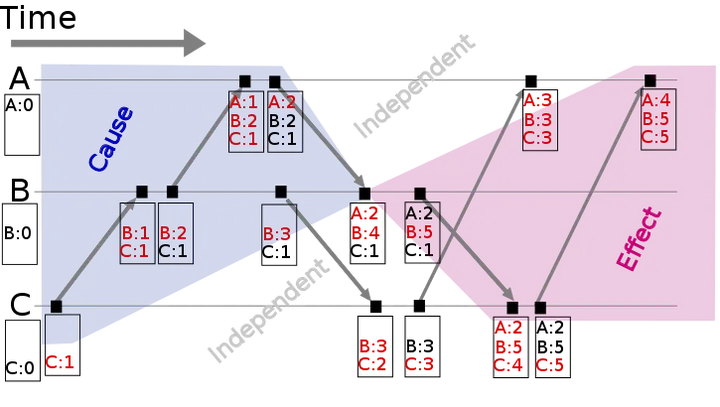
假设有事件 a、b 分别在节点 P、Q 上发生,Vector clock 分别为 Ta、Tb,如果 Tb[Q] > Ta[Q] 并且 Tb[P] >= Ta[P],则 a 发生于 b 之前,记作 a -> b。到目前为止还和 Lamport 时间戳差别不大,那 Vector clock 怎么判别同时发生关系呢?
如果 Tb[Q] > Ta[Q] 并且 Tb[P] < Ta[P],则认为 a、b 同时发生,记作 a <-> b。例如图 2 中节点 B 上的第 4 个事件 (A:2,B:4,C:1) 与节点 C 上的第 2 个事件 (B:3,C:2) 没有因果关系、属于同时发生事件。
版本向量时钟
基于 Vector clock 我们可以获得任意两个事件的顺序关系,结果或为先后顺序或为同时发生,识别事件顺序在工程实践中有很重要的引申应用,最常见的应用是发现数据冲突(detect conflict)。
分布式系统中数据一般存在多个副本(replication),多个副本可能被同时更新,这会引起副本间数据不一致,Version vector 的实现与 Vector clock 非常类似,目的用于发现数据冲突。下面通过一个例子说明 Version vector 的用法:
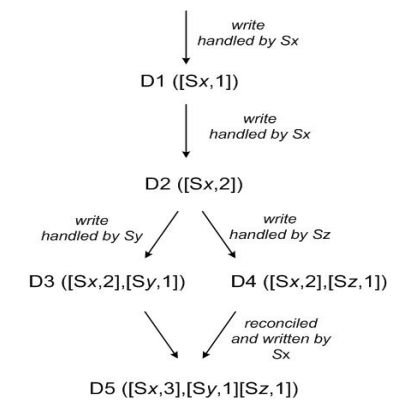
- client 端写入数据,该请求被 Sx 处理并创建相应的 vector ([Sx, 1]),记为数据 D1
- 第 2 次请求也被 Sx 处理,数据修改为 D2,vector 修改为([Sx, 2])
- 第 3、第 4 次请求分别被 Sy、Sz 处理,client 端先读取到 D2,然后 D3、D4 被写入 Sy、Sz
- 第 5 次更新时 client 端读取到 D2、D3 和 D4 3 个数据版本,通过类似 Vector clock 判断同时发生关系的方法可判断 D3、D4 存在数据冲突,最终通过一定方法解决数据冲突并写入 D5
Vector clock 只用于发现数据冲突,不能解决数据冲突。如何解决数据冲突因场景而异,具体方法有以最后更新为准(last write win),或将冲突的数据交给 client 由 client 端决定如何处理,或通过 quorum 决议事先避免数据冲突的情况发生(11)。
由于记录了所有数据在所有节点上的逻辑时钟信息,Vector clock 和 Version vector 在实际应用中可能面临的一个问题是 vector 过大,用于数据管理的元数据(meta data)甚至大于数据本(12)。
解决该问题的方法是使用 server id 取代 client id 创建 vector (因为 server 的数量相对 client 稳定),或设定最大的 size、如果超过该 size 值则淘汰最旧的 vector 信息(10)(13)。
应用场景
逻辑时钟在分布式系统中有广泛的应用:
1. 分布式数据库的并发控制
- DynamoDB:使用向量时钟检测数据冲突
- Riak:使用向量时钟管理数据的多个版本
- Cassandra:使用时间戳(类似 Lamport)解决 Last-Write-Wins 冲突
- Voldemort:使用向量时钟进行版本管理
2. 分布式锁与互斥
Lamport 时间戳可用于实现分布式互斥算法(如 Lamport 互斥算法),保证多个节点对共享资源的互斥访问。
3. 分布式消息系统
- 消息排序:保证跨节点的消息按照因果顺序传递
- 事件溯源:在事件溯源系统中,使用逻辑时钟对事件进行排序
4. 分布式快照与一致性检查
- Chandy-Lamport 算法:使用逻辑时钟实现分布式快照,用于死锁检测和全局状态检查
- Flink Checkpoint:类似思想用于流处理的检查点机制
5. 冲突检测与解决
- CRDT(Conflict-free Replicated Data Types):使用逻辑时钟实现无冲突的复制数据类型
- 协同编辑:如 Google Docs 使用类似机制检测编辑冲突
6. 分布式追踪
- 请求追踪:在微服务调用链中使用逻辑时钟排序事件
- 因果追踪:如 Apache HTrace 使用类似思想
最佳实践
案例 1:Lamport 逻辑时钟的 Java 实现
import java.util.concurrent.atomic.AtomicLong;

/**
 * Lamport 逻辑时钟实现
 *
 * 规则:
 * 1. 节点内部事件:时间戳 +1
 * 2. 发送消息事件:时间戳 +1,将时间戳附带在消息中
 * 3. 接收消息事件:时间戳 = Max(本地时间戳, 消息时间戳) + 1
 */
public class LamportClock {

    private final AtomicLong timestamp = new AtomicLong(0);

    /**
     * 节点内部事件:递增时间戳
     */
    public long tick() {
        return timestamp.incrementAndGet();
    }

    /**
     * 发送消息事件:递增时间戳并返回附带的时间戳
     */
    public long send() {
        return timestamp.incrementAndGet();
    }

    /**
     * 接收消息事件:更新时间戳
     *
     * @param receivedTimestamp 消息中附带的时间戳
     * @return 更新后的时间戳
     */
    public long receive(long receivedTimestamp) {
        long current, next;
        do {
            current = timestamp.get();
            next = Math.max(current, receivedTimestamp) + 1;
        } while (!timestamp.compareAndSet(current, next));
        return next;
    }

    /**
     * 获取当前时间戳
     */
    public long getCurrentTimestamp() {
        return timestamp.get();
    }

    /**
     * 比较两个 Lamport 时间戳(含节点 ID 以打破平局)
     *
     * @param ts1       时间戳1
     * @param nodeId1   节点 ID1
     * @param ts2       时间戳2
     * @param nodeId2   节点 ID2
     * @return 负数表示事件1在前,正数表示事件2在前,0 表示同一事件
     */
    public static int compare(long ts1, int nodeId1, long ts2, int nodeId2) {
        if (ts1 != ts2) {
            return Long.compare(ts1, ts2);
        }
        return Integer.compare(nodeId1, nodeId2);
    }

    public static void main(String[] args) throws InterruptedException {
        // 模拟 3 个节点的分布式系统
        LamportClock node1 = new LamportClock();
        LamportClock node2 = new LamportClock();
        LamportClock node3 = new LamportClock();

        System.out.println("=== Lamport 逻辑时钟演示 ===\n");

        // Node 1 内部事件
        long t1 = node1.tick();
        System.out.println("Node1 内部事件: timestamp=" + t1);

        // Node 1 向 Node 2 发送消息
        long sendTs = node1.send();
        System.out.println("Node1 发送消息给 Node2: 消息时间戳=" + sendTs);

        // Node 2 接收消息
        long recvTs = node2.receive(sendTs);
        System.out.println("Node2 接收来自 Node1 的消息: 更新后时间戳=" + recvTs);

        // Node 2 内部事件
        long t2 = node2.tick();
        System.out.println("Node2 内部事件: timestamp=" + t2);

        // Node 3 独立事件(与 Node 1/2 并发)
        long t3 = node3.tick();
        System.out.println("Node3 独立事件: timestamp=" + t3);

        // Node 2 向 Node 3 发送消息
        long sendTs2 = node2.send();
        System.out.println("Node2 发送消息给 Node3: 消息时间戳=" + sendTs2);

        // Node 3 接收消息
        long recvTs2 = node3.receive(sendTs2);
        System.out.println("Node3 接收来自 Node2 的消息: 更新后时间戳=" + recvTs2);

        // 使用节点 ID 实现全序
        System.out.println("\n=== 全序排序(使用节点 ID 打破平局)===");
        long[][] events = {{t1, 1}, {t2, 2}, {t3, 3}, {recvTs2, 3}};
        java.util.Arrays.sort(events, (a, b) -> {
            if (a[0] != b[0]) return Long.compare(a[0], b[0]);
            return Long.compare(a[1], b[1]);
        });
        for (long[] e : events) {
            System.out.println("  事件: timestamp=" + e[0] + ", nodeId=" + e[1]);
        }
    }
}
案例 2:向量时钟的 Java 实现
import java.util.Arrays;
import java.util.Map;
import java.util.concurrent.ConcurrentHashMap;

/**
 * 向量时钟实现
 *
 * 与 Lamport 时间戳不同,向量时钟可以:
 * 1. 准确判断两个事件的因果关系(a -> b 或 b -> a 或 并发)
 * 2. 检测并发冲突
 *
 * 结构:每个节点维护一个向量,记录所有节点的逻辑时间戳
 */
public class VectorClock {

    // 节点 ID -> 时间戳
    private final Map<Integer, Long> clock = new ConcurrentHashMap<>();
    // 当前节点 ID
    private final int nodeId;
    // 集群节点总数
    private final int clusterSize;

    public VectorClock(int nodeId, int clusterSize) {
        this.nodeId = nodeId;
        this.clusterSize = clusterSize;
        for (int i = 0; i < clusterSize; i++) {
            clock.put(i, 0L);
        }
    }

    /**
     * 节点内部事件:递增自己的时间戳
     */
    public Map<Integer, Long> tick() {
        clock.merge(nodeId, 1L, Long::sum);
        return new ConcurrentHashMap<>(clock);
    }

    /**
     * 发送消息事件:递增时间戳并返回当前向量时钟
     */
    public Map<Integer, Long> send() {
        return tick();
    }

    /**
     * 接收消息事件:合并远程向量时钟
     *
     * @param remoteClock 消息中附带的向量时钟
     */
    public Map<Integer, Long> receive(Map<Integer, Long> remoteClock) {
        // 合并:取每个分量的最大值
        for (Map.Entry<Integer, Long> entry : remoteClock.entrySet()) {
            clock.merge(entry.getKey(), entry.getValue(), Math::max);
        }
        // 递增自己的时间戳
        clock.merge(nodeId, 1L, Long::sum);
        return new ConcurrentHashMap<>(clock);
    }

    /**
     * 比较两个向量时钟
     *
     * @return -1: vc1 -> vc2 (vc1 发生在 vc2 之前)
     *          0: vc1 <-> vc2 (并发)
     *          1: vc2 -> vc1 (vc2 发生在 vc1 之前)
     */
    public static int compare(Map<Integer, Long> vc1, Map<Integer, Long> vc2) {
        boolean vc1LessThanOrEqual = true;  // vc1 <= vc2
        boolean vc2LessThanOrEqual = true;  // vc2 <= vc1

        for (Integer key : vc1.keySet()) {
            long t1 = vc1.getOrDefault(key, 0L);
            long t2 = vc2.getOrDefault(key, 0L);
            if (t1 > t2) vc1LessThanOrEqual = false;
            if (t2 > t1) vc2LessThanOrEqual = false;
        }

        if (vc1LessThanOrEqual && vc2LessThanOrEqual) {
            return 0; // 相等
        } else if (vc1LessThanOrEqual) {
            return -1; // vc1 -> vc2
        } else if (vc2LessThanOrEqual) {
            return 1;  // vc2 -> vc1
        } else {
            return 0; // 并发
        }
    }

    /**
     * 判断两个事件是否并发
     */
    public static boolean isConcurrent(Map<Integer, Long> vc1, Map<Integer, Long> vc2) {
        return compare(vc1, vc2) == 0 && !vc1.equals(vc2);
    }

    public Map<Integer, Long> getClock() {
        return new ConcurrentHashMap<>(clock);
    }

    public int getNodeId() {
        return nodeId;
    }

    @Override
    public String toString() {
        return "VC" + nodeId + ": " + clock;
    }

    public static void main(String[] args) {
        System.out.println("=== 向量时钟演示 ===\n");

        // 3 节点集群
        VectorClock node0 = new VectorClock(0, 3);
        VectorClock node1 = new VectorClock(1, 3);
        VectorClock node2 = new VectorClock(2, 3);

        // Node0 内部事件
        Map<Integer, Long> e1 = node0.tick();
        System.out.println("事件 e1 (Node0 内部): " + e1);

        // Node0 发送消息给 Node1
        Map<Integer, Long> msg1 = node0.send();
        System.out.println("Node0 发送消息,向量时钟: " + msg1);

        // Node1 接收消息
        Map<Integer, Long> e2 = node1.receive(msg1);
        System.out.println("事件 e2 (Node1 接收): " + e2);

        // Node2 独立事件(与 e1, e2 并发)
        Map<Integer, Long> e3 = node2.tick();
        System.out.println("事件 e3 (Node2 独立): " + e3);

        System.out.println("\n=== 因果关系判断 ===");
        System.out.println("e1 -> e2? " + (compare(e1, e2) == -1 ? "是" : "否"));
        System.out.println("e1 -> e3? " + (compare(e1, e3) == -1 ? "是" : "否"));
        System.out.println("e2 -> e3? " + (compare(e2, e3) == -1 ? "是" : "否"));
        System.out.println("e2 和 e3 并发? " + (isConcurrent(e2, e3) ? "是" : "否"));
    }
}
案例 3:基于向量时钟的冲突检测系统
以下示例展示如何在实际的数据存储系统中使用向量时钟检测和解决数据冲突:
import java.util.*;
import java.util.concurrent.ConcurrentHashMap;

/**
 * 基于向量时钟的分布式数据存储冲突检测
 * 模拟 DynamoDB / Riak 的版本管理机制
 */
public class VectorClockStorage {

    // 数据存储:key -> 多个版本的数据
    private final Map<String, List<VersionedValue>> store = new ConcurrentHashMap<>();
    // 节点列表
    private final List<StorageNode> nodes;

    public VectorClockStorage(int nodeCount) {
        this.nodes = new ArrayList<>();
        for (int i = 0; i < nodeCount; i++) {
            this.nodes.add(new StorageNode(i, nodeCount, this));
        }
    }

    /**
     * 带版本的数据
     */
    public static class VersionedValue {
        final String value;
        final Map<Integer, Long> vectorClock;

        public VersionedValue(String value, Map<Integer, Long> vectorClock) {
            this.value = value;
            this.vectorClock = new ConcurrentHashMap<>(vectorClock);
        }

        public boolean isConcurrentWith(VersionedValue other) {
            return VectorClock.isConcurrent(this.vectorClock, other.vectorClock);
        }

        @Override
        public String toString() {
            return "Value='" + value + "', VC=" + vectorClock;
        }
    }

    /**
     * 存储节点
     */
    public static class StorageNode {
        private final int nodeId;
        private final VectorClock vectorClock;
        private final VectorClockStorage storage;

        public StorageNode(int nodeId, int clusterSize, VectorClockStorage storage) {
            this.nodeId = nodeId;
            this.vectorClock = new VectorClock(nodeId, clusterSize);
            this.storage = storage;
        }

        /**
         * 写入数据
         */
        public void put(String key, String value) {
            Map<Integer, Long> vc = vectorClock.tick();
            VersionedValue versionedValue = new VersionedValue(value, vc);

            storage.store.compute(key, (k, existingVersions) -> {
                if (existingVersions == null) {
                    List<VersionedValue> list = new ArrayList<>();
                    list.add(versionedValue);
                    return list;
                }

                // 检查是否有冲突
                List<VersionedValue> newVersions = new ArrayList<>();
                boolean hasConflict = false;

                for (VersionedValue existing : existingVersions) {
                    int cmp = VectorClock.compare(existing.vectorClock, vc);
                    if (cmp == -1) {
                        // 新版本覆盖旧版本,不保留旧版本
                        continue;
                    } else if (cmp == 1) {
                        // 旧版本更新,保留旧版本
                        newVersions.add(existing);
                    } else if (existing.isConcurrentWith(versionedValue)) {
                        // 并发冲突,保留两个版本
                        newVersions.add(existing);
                        hasConflict = true;
                    }
                }
                newVersions.add(versionedValue);

                if (hasConflict) {
                    System.out.println("[Node " + nodeId + "] 检测到数据冲突! key="
                        + key + ", 冲突版本数=" + newVersions.size());
                }
                return newVersions;
            });
        }

        /**
         * 读取数据
         */
        public List<VersionedValue> get(String key) {
            return storage.store.getOrDefault(key, Collections.emptyList());
        }

        /**
         * 解决冲突(Last-Write-Wins 策略)
         */
        public VersionedValue resolveConflict(String key, String resolvedValue) {
            Map<Integer, Long> vc = vectorClock.tick();
            VersionedValue resolved = new VersionedValue(resolvedValue, vc);

            List<VersionedValue> single = new ArrayList<>();
            single.add(resolved);
            storage.store.put(key, single);

            System.out.println("[Node " + nodeId + "] 冲突已解决: key="
                + key + ", value=" + resolvedValue);
            return resolved;
        }

        public int getNodeId() { return nodeId; }
    }

    public List<StorageNode> getNodes() { return nodes; }

    public static void main(String[] args) {
        System.out.println("=== 向量时钟冲突检测演示 ===\n");

        // 创建 3 节点存储集群
        VectorClockStorage storage = new VectorClockStorage(3);
        StorageNode node0 = storage.getNodes().get(0);
        StorageNode node1 = storage.getNodes().get(1);
        StorageNode node2 = storage.getNodes().get(2);

        String key = "user:1001:name";

        // 1. Node0 写入初始值
        System.out.println("--- 步骤 1: Node0 写入初始值 ---");
        node0.put(key, "Alice");
        System.out.println("当前版本: " + node0.get(key));

        // 2. Node1 和 Node2 同时读取旧值后各自更新(模拟并发写)
        System.out.println("\n--- 步骤 2: Node1 和 Node2 并发更新 ---");
        // 模拟网络分区,Node1 和 Node2 看不到 Node0 的更新
        StorageNode independentNode1 = new StorageNode(1, 3, storage);
        StorageNode independentNode2 = new StorageNode(2, 3, storage);

        independentNode1.put(key, "Bob");
        independentNode2.put(key, "Charlie");

        // 3. 检测冲突
        System.out.println("\n--- 步骤 3: 读取并检测冲突 ---");
        List<VersionedValue> versions = node0.get(key);
        System.out.println("key=" + key + " 的所有版本:");
        for (VersionedValue v : versions) {
            System.out.println("  " + v);
        }

        // 4. 解决冲突
        System.out.println("\n--- 步骤 4: 解决冲突 ---");
        if (versions.size() > 1) {
            // 使用 Last-Write-Wins 策略(实际可能由应用层决定)
            node0.resolveConflict(key, "Bob");
            System.out.println("解决后的版本: " + node0.get(key));
        }

        System.out.println("\n=== 结论 ===");
        System.out.println("向量时钟可以准确检测到并发写冲突");
        System.out.println("冲突解决策略由应用层决定(LWW、应用合并、用户决策等)");
    }
}
常见问题
问题 1:Lamport 时间戳误判因果关系
问题描述:使用 Lamport 时间戳判断事件先后顺序时,出现了错误的因果关系判断——两个并发的事件被误判为有因果关系。
原因分析:
Lamport 时间戳的核心局限:a -> b 蕴含 C(a) < C(b),但 C(a) < C(b) 不蕴含 a -> b。也就是说,时间戳小的事件不一定发生在时间戳大的事件之前。
例如:
- Node A 执行内部事件,C(A) = 1
- Node B 独立执行内部事件,C(B) = 1
这两个事件是并发的(没有因果关系),但 Lamport 时间戳相同,如果加上节点 ID 排序,会被误判为有先后顺序。
解决方案:使用向量时钟替代 Lamport 时间戳,向量时钟能准确判断因果关系和并发关系。
import java.util.*;

/**
 * 演示 Lamport 时间戳的因果误判问题
 * 以及向量时钟如何解决该问题
 */
public class CausalOrderingIssue {

    /**
     * Lamport 时间戳(标量)
     */
    static class LamportTimestamp {
        private long timestamp = 0;
        private final int nodeId;

        LamportTimestamp(int nodeId) {
            this.nodeId = nodeId;
        }

        long tick() { return ++timestamp; }
        long send() { return ++timestamp; }
        long receive(long remote) {
            timestamp = Math.max(timestamp, remote) + 1;
            return timestamp;
        }
        long get() { return timestamp; }
    }

    /**
     * 向量时钟
     */
    static class VectorClockTS {
        private final long[] clock;
        private final int nodeId;

        VectorClockTS(int nodeId, int size) {
            this.nodeId = nodeId;
            this.clock = new long[size];
        }

        long[] tick() { clock[nodeId]++; return clock.clone(); }
        long[] send() { return tick(); }
        long[] receive(long[] remote) {
            for (int i = 0; i < clock.length; i++) {
                clock[i] = Math.max(clock[i], remote[i]);
            }
            clock[nodeId]++;
            return clock.clone();
        }

        /**
         * 判断因果关系
         * @return -1: a->b, 1: b->a, 0: 并发或相等
         */
        static int compare(long[] a, long[] b) {
            boolean aLe = true, bLe = true;
            for (int i = 0; i < a.length; i++) {
                if (a[i] > b[i]) aLe = false;
                if (b[i] > a[i]) bLe = false;
            }
            if (aLe && bLe) return 0;
            if (aLe) return -1;
            if (bLe) return 1;
            return 0; // 并发
        }

        static boolean isConcurrent(long[] a, long[] b) {
            return compare(a, b) == 0 && !Arrays.equals(a, b);
        }
    }

    public static void main(String[] args) {
        System.out.println("=== Lamport 时间戳因果误判问题 ===\n");

        // --- 场景:两个节点独立操作(并发) ---

        // Lamport 时间戳
        LamportTimestamp lamportA = new LamportTimestamp(0);
        LamportTimestamp lamportB = new LamportTimestamp(1);

        long la1 = lamportA.tick(); // A 内部事件
        long lb1 = lamportB.tick(); // B 内部事件(与 A 并发)

        System.out.println("--- Lamport 时间戳 ---");
        System.out.println("事件 A (Node 0): timestamp=" + la1);
        System.out.println("事件 B (Node 1): timestamp=" + lb1);
        System.out.println("Lamport 判断: A 在 B 之前? "
            + (la1 < lb1 || (la1 == lb1 && 0 < 1)));
        // 误判:Lamport 认为 A 在 B 之前,但实际上它们是并发的!
        System.out.println("实际情况: A 和 B 是并发的(无因果关系)");
        System.out.println("结论: Lamport 时间戳导致了因果误判!\n");

        // 向量时钟
        VectorClockTS vcA = new VectorClockTS(0, 2);
        VectorClockTS vcB = new VectorClockTS(1, 2);

        long[] va1 = vcA.tick(); // A 内部事件
        long[] vb1 = vcB.tick(); // B 内部事件(与 A 并发)

        System.out.println("--- 向量时钟 ---");
        System.out.println("事件 A: VC=" + Arrays.toString(va1));
        System.out.println("事件 B: VC=" + Arrays.toString(vb1));
        System.out.println("向量时钟判断并发? "
            + VectorClockTS.isConcurrent(va1, vb1));
        // 正确判断:A 和 B 是并发的
        System.out.println("结论: 向量时钟正确识别了并发关系!");
    }
}
问题 2:向量时钟的空间膨胀问题
问题描述:在大规模分布式系统中,向量时钟的大小与节点数成正比,随着节点数量增加或节点频繁加入/退出,向量时钟占用的空间不断膨胀,甚至超过数据本身的大小。
原因分析:
向量时钟的大小为 O(n)(n 为节点数)。在以下场景中问题尤为严重:
- 节点数量多(如 1000+ 节点的 P2P 网络)
- 节点频繁加入和退出(向量需要保留已退出节点的条目)
- 数据量小但版本多(元数据开销超过数据本身)
解决方案:使用压缩技术或替代方案。
import java.util.*;
import java.util.concurrent.ConcurrentHashMap;

/**
 * 向量时钟空间优化方案
 */
public class VectorClockOptimization {

    /**
     * 方案 1:稀疏向量时钟
     * 只记录非零的节点时间戳,适用于节点多但交互少的场景
     */
    public static class SparseVectorClock {
        private final Map<Integer, Long> clock = new ConcurrentHashMap<>();
        private final int nodeId;

        public SparseVectorClock(int nodeId) {
            this.nodeId = nodeId;
        }

        public Map<Integer, Long> tick() {
            clock.merge(nodeId, 1L, Long::sum);
            return new HashMap<>(clock);
        }

        public Map<Integer, Long> receive(Map<Integer, Long> remote) {
            remote.forEach((k, v) -> clock.merge(k, v, Math::max));
            clock.merge(nodeId, 1L, Long::sum);
            return new HashMap<>(clock);
        }

        /**
         * 清理长时间不活跃的节点
         */
        public void pruneInactiveNodes(Set<Integer> activeNodes, long threshold) {
            clock.entrySet().removeIf(e ->
                !activeNodes.contains(e.getKey()) && e.getValue() < threshold);
        }
    }

    /**
     * 方案 2:Dotted Version Vector
     * 每个事件使用 (节点ID, 事件序号) 的点对,比完整向量更紧凑
     */
    public static class DottedVersionVector {
        // 已知的版本上下文
        private final Map<Integer, Long> context = new ConcurrentHashMap<>();
        // 当前事件的点
        private Map<Integer, Long> dot;
        private final int nodeId;

        public DottedVersionVector(int nodeId) {
            this.nodeId = nodeId;
        }

        public void tick() {
            long seq = context.merge(nodeId, 1L, Long::sum);
            dot = new HashMap<>();
            dot.put(nodeId, seq);
        }

        public void receive(Map<Integer, Long> remoteContext,
                            Map<Integer, Long> remoteDot) {
            // 合并上下文
            remoteContext.forEach((k, v) -> context.merge(k, v, Math::max));
            // 合并 dot
            if (remoteDot != null) {
                remoteDot.forEach((k, v) -> context.merge(k, v, Math::max));
            }
            tick();
        }
    }

    public static void main(String[] args) {
        System.out.println("=== 向量时钟空间优化方案 ===\n");

        // 对比不同方案的空间占用
        System.out.println("--- 空间占用对比 ---");
        System.out.println("| 方案               | 空间复杂度 | 适用场景                    |");
        System.out.println("|---------------------|------------|-----------------------------|");
        System.out.println("| 完整向量时钟         | O(n)       | 小规模集群, 节点稳定         |");
        System.out.println("| 稀疏向量时钟         | O(k) k<<n  | 大规模集群, 局部交互         |");
        System.out.println("| Dotted Version Vec  | O(1)~O(k)  | 频繁写入, 需要精确版本追踪   |");
        System.out.println("| 版本向量 + GC        | O(n)       | 通用, 定期清理无效条目       |");

        System.out.println("\n--- 稀疏向量时钟示例 ---");
        // 1000 个节点,但每个节点只与少数节点交互
        SparseVectorClock sparse = new SparseVectorClock(0);
        // 只与 3 个节点交互
        Map<Integer, Long> remote1 = new HashMap<>();
        remote1.put(5, 10L);
        sparse.receive(remote1);

        Map<Integer, Long> remote2 = new HashMap<>();
        remote2.put(10, 20L);
        sparse.receive(remote2);

        System.out.println("1000 节点集群中,稀疏向量时钟大小: "
            + sparse.clock.size() + " (完整向量时钟需要 1000)");

        System.out.println("\n--- 优化建议 ---");
        System.out.println("1. 优先使用稀疏向量时钟,只记录有交互的节点");
        System.out.println("2. 定期执行垃圾回收,清理不活跃节点的条目");
        System.out.println("3. 使用 server ID 而非 client ID(server 数量更稳定)");
        System.out.println("4. 设定向量大小上限,超过后使用 LWW 降级策略");
        System.out.println("5. 考虑使用 Dotted Version Vector 等高效变体");
    }
}
问题 3:物理时钟不同步导致的超时误判
问题描述:在分布式系统中,由于各节点的物理时钟存在偏差,导致基于时间戳的超时判断出现错误——实际上未超时的请求被误判为超时,或已超时的请求未被检测到。
原因分析:
尽管逻辑时钟解决了因果关系排序问题,但许多实际场景仍依赖物理时钟:
- 请求超时检测
- 缓存过期
- 日志时间戳
- 监控指标统计
物理时钟不同步的原因:
- NTP 同步精度有限(通常毫秒级,跨机房可能更差)
- 网络延迟波动
- 时钟漂移(硬件晶振差异)
- 闰秒处理
解决方案:结合逻辑时钟和物理时钟,使用混合逻辑时钟(HLC, Hybrid Logical Clock)。
import java.util.concurrent.atomic.AtomicReference;

/**
 * 混合逻辑时钟 (Hybrid Logical Clock, HLC)
 *
 * 结合物理时钟和逻辑时钟的优点:
 * - 物理时钟:提供与实际时间的近似性
 * - 逻辑时钟:保证因果关系
 *
 * HLC 结构:(physical_timestamp, logical_counter)
 */
public class HybridLogicalClock {

    // HLC 状态:物理时间戳 + 逻辑计数器
    private final AtomicReference<HLC> current = new AtomicReference<>(
        new HLC(System.currentTimeMillis(), 0));

    /**
     * HLC 时间戳
     */
    public static class HLC implements Comparable<HLC> {
        final long physical;  // 物理时间戳(毫秒)
        final long logical;   // 逻辑计数器

        public HLC(long physical, long logical) {
            this.physical = physical;
            this.logical = logical;
        }

        @Override
        public int compareTo(HLC other) {
            if (this.physical != other.physical) {
                return Long.compare(this.physical, other.physical);
            }
            return Long.compare(this.logical, other.logical);
        }

        @Override
        public String toString() {
            return "HLC(physical=" + physical + ", logical=" + logical + ")";
        }
    }

    /**
     * 本地事件:生成新的 HLC
     */
    public HLC tick() {
        HLC old, next;
        do {
            old = current.get();
            long now = System.currentTimeMillis();

            if (now > old.physical) {
                // 物理时钟前进,重置逻辑计数器
                next = new HLC(now, 0);
            } else {
                // 物理时钟未前进,递增逻辑计数器
                next = new HLC(old.physical, old.logical + 1);
            }
        } while (!current.compareAndSet(old, next));
        return next;
    }

    /**
     * 发送消息事件
     */
    public HLC send() {
        return tick();
    }

    /**
     * 接收消息事件:合并远程 HLC
     */
    public HLC receive(HLC remote) {
        HLC old, next;
        do {
            old = current.get();
            long now = System.currentTimeMillis();
            long maxPhysical = Math.max(Math.max(now, old.physical), remote.physical);

            long newLogical;
            if (maxPhysical == old.physical && maxPhysical == remote.physical) {
                newLogical = Math.max(old.logical, remote.logical) + 1;
            } else if (maxPhysical == old.physical) {
                newLogical = old.logical + 1;
            } else if (maxPhysical == remote.physical) {
                newLogical = remote.logical + 1;
            } else {
                newLogical = 0;
            }
            next = new HLC(maxPhysical, newLogical);
        } while (!current.compareAndSet(old, next));
        return next;
    }

    public HLC getCurrent() {
        return current.get();
    }

    public static void main(String[] args) throws InterruptedException {
        System.out.println("=== 混合逻辑时钟 (HLC) 演示 ===\n");

        HybridLogicalClock nodeA = new HybridLogicalClock();
        HybridLogicalClock nodeB = new HybridLogicalClock();

        // 模拟时钟偏差:Node B 的物理时钟比 Node A 慢 5 秒
        System.out.println("--- 初始状态 ---");
        System.out.println("Node A HLC: " + nodeA.getCurrent());
        System.out.println("Node B HLC: " + nodeB.getCurrent());

        // Node A 本地事件
        HLC a1 = nodeA.tick();
        System.out.println("\nNode A 本地事件: " + a1);

        // Node A 发送消息给 Node B
        HLC sendHlc = nodeA.send();
        System.out.println("Node A 发送消息: " + sendHlc);

        // Node B 接收消息
        HLC b1 = nodeB.receive(sendHlc);
        System.out.println("Node B 接收消息: " + b1);
        // HLC 保证了因果顺序:即使 Node B 物理时钟慢,也能正确排序

        // Node B 本地事件
        HLC b2 = nodeB.tick();
        System.out.println("Node B 本地事件: " + b2);

        System.out.println("\n--- 因果关系验证 ---");
        System.out.println("a1 -> b1? " + (a1.compareTo(b1) < 0));
        System.out.println("b1 -> b2? " + (b1.compareTo(b2) < 0));

        System.out.println("\n=== HLC 的优势 ===");
        System.out.println("1. 保留物理时间信息,便于调试和监控");
        System.out.println("2. 保证因果关系(类似 Lamport 时间戳)");
        System.out.println("3. 容忍时钟偏差(逻辑计数器弥补物理时钟差异)");
        System.out.println("4. 向后兼容物理时间戳的使用场景");
        System.out.println("\n--- 应用场景 ---");
        System.out.println("- Google Spanner: 使用 TrueTime + 类似机制");
        System.out.println("- CockroachDB: 使用 HLC 实现一致性");
        System.out.println("- MongoDB: 使用类似的混合时间戳");
    }
}
参考资料
- Time, Clocks, and the Ordering of Events in a Distributed System,译文,解读 - Lamport 介绍 happened before、偏序关系(partial ordering)、逻辑时钟(Logical Clocks)概念,提出解决分布式系统中区分事件发生的时序问题的方法。
- Virtual Time and Global States of Distributed Systems,解读 - 逻辑时钟无法描述事件的因果关系。本文提出了向量时钟,这种算法利用了向量这种数据结构将全局各个进程的逻辑时间戳广播给各个进程,通过向量时间戳就能够比较任意两个事件的因果关系。
- 分布式系统理论基础 - 时间、时钟和事件顺序
- https://writings.sh/post/logical-clocks